How Many Solar Panels Do I Need for My Home?
Switching to solar energy in Pakistan is no longer just a trend — it’s a practical decision for homeowners who want to cut electricity costs and gain energy independence.
If you’re wondering, “How many solar panels do I need for my home?”, this guide simplifies everything you need to know, based on real usage patterns in Pakistan.
Step 1: Understand Your Energy Consumption
Before you decide on the number of solar panels, examine your electricity usage.
Here is an Example:
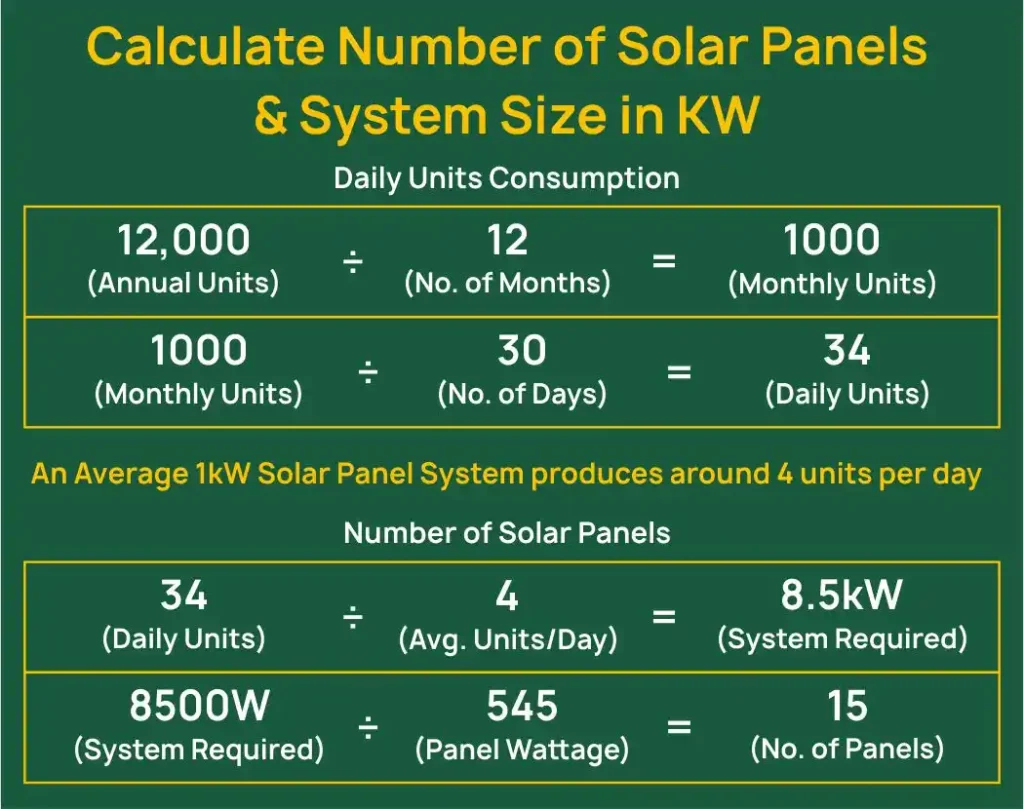
- Annual Consumption: 12,000 kWh
- Monthly Average: 1,000 kWh
- Daily Average: ≈ 34 kWh
Since 1kW solar system generates about 4 kWh/day, you would need:
34 ÷ 4 = 8.5 kW system
Actual needs may vary based on regional sunlight and panel efficiency.
Step 2: Match System Size to Home Type
Every home in Pakistan has different energy needs based on size and occupancy.
| Home Size | Daily Use (kWh) | System Size (kW) | Panels (545W) |
|---|---|---|---|
| 5 Marla (~1250 sq. ft.) | 15–20 | 4–5 | 8–10 |
| 10 Marla (~2500 sq. ft.) | 25–35 | 7–9 | 13–17 |
| 1 Kanal (~5000 sq. ft.) | 35–45 | 9–12 | 17–22 |
Step 3: Consider Appliance Load
Solar panel needs also depend on the appliances you regularly use.
| Appliance | Power (W) | Daily Use (hrs) | Daily Units (kWh) |
|---|---|---|---|
| 1.5 Ton AC | 1500 | 6 | 9.0 |
| Refrigerator | 200 | 24 | 4.8 |
| Fans (x5) | 75 | 10 | 3.75 |
| Lights (x10) | 20 | 6 | 1.2 |
Total: ~18.75 kWh/day → 5–6 kW system ideal
Step 4: Assess Your Rooftop Capacity
Your roof’s available space directly affects how many solar panels you can install.
| System Size | Panels (545W) | Roof Area (sq. ft.) |
|---|---|---|
| 5 kW | 9–10 | 450–500 |
| 10 kW | 17–19 | 900–1000 |
| 15 kW | 27–30 | 1400–1600 |
Tip: Choose high-efficiency solar panels if space is limited.
Step 5: Factor in Location & Sunlight
Different cities in Pakistan receive varying amounts of sunlight, which affects solar output.
| City | Avg. Sunlight Hours/Day |
|---|---|
| Karachi | 5.5–6 |
| Lahore | 5–5.5 |
| Islamabad | 4.5–5 |
| Quetta | 6–6.5 |
Locations with more sunlight need fewer panels to produce the same amount of energy.
Step 6: On-Grid vs. Hybrid Solar Systems
Choosing the right type of solar setup is critical.
On-Grid:
- Connected to WAPDA grid
- Lower cost
- No power backup during outages
Hybrid:
- Includes battery storage
- Backup power for outages
- Higher initial cost but more reliable
If you want backup during outages, go for a hybrid system.
Hybrid System Benefits
In a Hybrid system, you combine solar panels with batteries, giving you backup power during outages while still enjoying energy savings.
Requirements:
- Solar panels and inverter compatible with battery storage
- Battery bank (Lithium-ion or Lead-Acid)
- Optional: Grid connection for net metering
- Space for battery installation and ventilation
Benefits:
- Backup power during load shedding or blackouts
- Lower electricity bills
- Greater energy independence
- Can still export excess energy (if net metering is enabled)
On Grid System Benefits
In On Grid system you sell excess solar electricity back to the grid, reducing your bill. Remember, on-grid systems don’t provide backup during outage.
Requirements:
- 3-phase electricity connection
- Solar system between 1 kW to 1 MW
- Approval from local DISCO (e.g., LESCO, MEPCO)
Benefits:
- Lower electricity bills
- Reduced grid dependence
- Supports clean energy
Final Recommendation
For a typical 10 Marla house with 13,000–16,000 kWh annual usage:
- Recommended System: 10–12 kW
- Panels Needed: 18–22 (545W)
- Net Metering: Strongly advised for cost savings
Still unsure about your system size? Use our Solar Calculator to calculate your daily energy consumption.
Start your solar journey with Implecso and take control of your energy future.